
Mural Jesús Pobre
Tardor Graffiti urban mural: symbol of power, creativity and hope in public space
Urban art has the power to transform any public space into a living canvas, capable of telling stories, transmitting emotions and provoking deep reflections. The mural created by Tardor Graffiti is a clear example of this transformative capacity. With a vibrant style and an intense symbolic charge, this work invites those who contemplate it to stop and immerse themselves in a visual universe full of meaning.
A female figure as a center of power and creativity
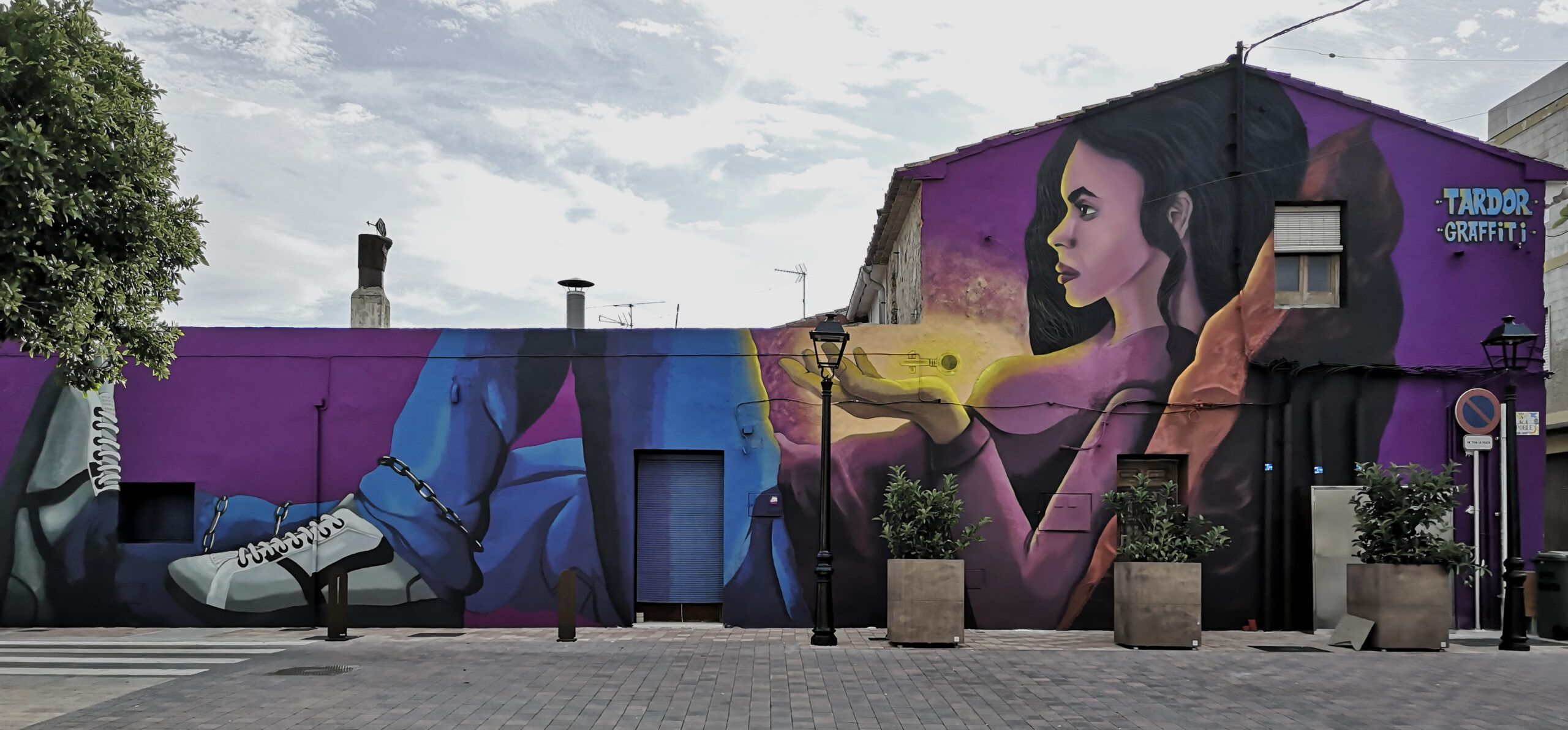
At the heart of this mural is a female figure holding a luminous sphere in her hands. This sphere can be interpreted in multiple ways: as a symbol of personal power, latent creativity, inner light or even the hope that each individual carries in his or her being. The woman’s posture and expression convey a mixture of serenity and determination, reflecting the strength that emanates from self-knowledge and creative capacity.
This focus on the female figure is no coincidence; it represents a tribute to vital energy and the capacity to generate change, both individually and collectively. The woman as a bearer of light and power symbolizes hope for a better future, a call to awaken the potential we all carry within.
Chromatic palette that intensifies the atmosphere
The predominant tones in the mural are purple, blue and black, colors that contribute to create a mystical and profound atmosphere. Purple, historically associated with spirituality and transformation, adds an introspective component. Blue, which refers to calm, balance and inspiration, balances the intensity of the scene. Meanwhile, black acts as a dramatic backdrop that enhances the details and accentuates the contrast, making the luminous sphere and the female figure shine brightly.
This careful chromatic selection not only adds aesthetic beauty, but also underlines the symbolism of the work, enhancing its message and connecting emotionally with the viewer.
Symbolic details: the chained slipper as a metaphor for freedom and hope
One of the most striking elements is the slipper on chains that appears on the left side of the mural. This detail can be interpreted as a powerful metaphor for freedom and hope. The chain, traditionally associated with oppression or limitation, contrasts with the slipper, which symbolizes movement, action and advancement.
This duality suggests the struggle to free oneself from bondage, whether physical, mental or social, and the yearning to move towards a state of greater autonomy and personal fulfillment. In the context of the mural, this symbol reinforces the message of empowerment and growth present in the central figure.
Urban art as a tool for social and cultural transformation
The Tardor mural is not only a visual work; it is an intervention in public space that invites the community to reflect on universal themes such as personal power, creativity, freedom and hope. This type of urban art contributes to humanizing cities, giving voice to social concerns and fostering dialogue between people.
Moreover, by being accessible to all, muralism democratizes art and turns the streets into open galleries, where anyone can connect with the message and find inspiration. Works like this transform walls into authentic cultural and emotional meeting points.
Tardor’s signature: a style that blends technique and message
The mural reflects Tardor Graffiti‘s characteristic stamp, which combines a refined technique with a deep symbolic content. Its vibrant urban style is highlighted by the use of intense colors, dynamic compositions and the ability to tell stories through the image.
In this mural, Tardor manages to fuse the strength of street art with a message that transcends aesthetics to address issues of identity, power and hope. The work thus becomes a bridge between the visual and the conceptual, inviting a complete experience.
Conclusion: a mural that illuminates and empowers urban space.
Tardor Graffiti’s mural is much more than just a painting on a wall; it is a symbol of light, power and freedom that transforms public space into a place of reflection and connection. With its combination of colors, symbols and technique, the work invites everyone to discover their own inner strength and to move forward with hope towards a future full of possibilities.
C/ Diagonal, 1, 03749 Jesus Pobre


{je_projects_ano}
Mural Jesús Pobre
Tardor Graffiti urban mural: symbol of power, creativity and hope in public space
Urban art has the power to transform any public space into a living canvas, capable of telling stories, transmitting emotions and provoking deep reflections. The mural created by Tardor Graffiti is a clear example of this transformative capacity. With a vibrant style and an intense symbolic charge, this work invites those who contemplate it to stop and immerse themselves in a visual universe full of meaning.
A female figure as a center of power and creativity
At the heart of this mural is a female figure holding a luminous sphere in her hands. This sphere can be interpreted in multiple ways: as a symbol of personal power, latent creativity, inner light or even the hope that each individual carries in his or her being. The woman’s posture and expression convey a mixture of serenity and determination, reflecting the strength that emanates from self-knowledge and creative capacity.
This focus on the female figure is no coincidence; it represents a tribute to vital energy and the capacity to generate change, both individually and collectively. The woman as a bearer of light and power symbolizes hope for a better future, a call to awaken the potential we all carry within.
Chromatic palette that intensifies the atmosphere
The predominant tones in the mural are purple, blue and black, colors that contribute to create a mystical and profound atmosphere. Purple, historically associated with spirituality and transformation, adds an introspective component. Blue, which refers to calm, balance and inspiration, balances the intensity of the scene. Meanwhile, black acts as a dramatic backdrop that enhances the details and accentuates the contrast, making the luminous sphere and the female figure shine brightly.
This careful chromatic selection not only adds aesthetic beauty, but also underlines the symbolism of the work, enhancing its message and connecting emotionally with the viewer.
Symbolic details: the chained slipper as a metaphor for freedom and hope
One of the most striking elements is the slipper on chains that appears on the left side of the mural. This detail can be interpreted as a powerful metaphor for freedom and hope. The chain, traditionally associated with oppression or limitation, contrasts with the slipper, which symbolizes movement, action and advancement.
This duality suggests the struggle to free oneself from bondage, whether physical, mental or social, and the yearning to move towards a state of greater autonomy and personal fulfillment. In the context of the mural, this symbol reinforces the message of empowerment and growth present in the central figure.
Urban art as a tool for social and cultural transformation
The Tardor mural is not only a visual work; it is an intervention in public space that invites the community to reflect on universal themes such as personal power, creativity, freedom and hope. This type of urban art contributes to humanizing cities, giving voice to social concerns and fostering dialogue between people.
Moreover, by being accessible to all, muralism democratizes art and turns the streets into open galleries, where anyone can connect with the message and find inspiration. Works like this transform walls into authentic cultural and emotional meeting points.
Tardor’s signature: a style that blends technique and message
The mural reflects Tardor Graffiti‘s characteristic stamp, which combines a refined technique with a deep symbolic content. Its vibrant urban style is highlighted by the use of intense colors, dynamic compositions and the ability to tell stories through the image.
In this mural, Tardor manages to fuse the strength of street art with a message that transcends aesthetics to address issues of identity, power and hope. The work thus becomes a bridge between the visual and the conceptual, inviting a complete experience.
Conclusion: a mural that illuminates and empowers urban space.
Tardor Graffiti’s mural is much more than just a painting on a wall; it is a symbol of light, power and freedom that transforms public space into a place of reflection and connection. With its combination of colors, symbols and technique, the work invites everyone to discover their own inner strength and to move forward with hope towards a future full of possibilities.